Sunday, October 2, 2011

The Complete Case Files 11


(Reprints: Judge Dredd stories from 2000 AD Prog 523-570)

An elephant in the room: some enterprising person or group of fans decided, at some point, that they could do the Complete Case Files books better. There are digital bootleg versions of the early Case Files floating around online; the difference is that the bootlegs have color where the original pages were printed in color (the first two pages of most episodes before mid-1988), and they insert all the Dredd-related-but-not-Judge Dredd-proper stories at the appropriate point in the narrative.


For a lot of the earlier volumes, that's a minor improvement. (For some, it's an actively bad idea--at least one bootleg I've seen gets a lot of its color pages from badly chopped-up and reformatted American reprints.) But in 1987, 2000 AD's production values were ramped up a bit, and as of a few episodes before Case Files 11 begins, the opening spread of the Judge Dredd feature was suddenly in painted color. The half-tone versions of the color pages in the printed Case Files 11 is decent--although it still gets muddy in a few places, like the beginning of "Return of Death Fist"--but it's distinctly not the way these stories were intended to look. And the bootleg files also include other Dredd-related pages from the original publications, the most interesting of which this time is this one, which was printed in the issue before "Oz" started:


There are a lot of in-jokes going on here, most of which I don't get and bet I'm not supposed to get, but the implication is that seven members of the 2000 AD staff had gone to Australia to research "Oz." (Was that the case?) The bent-over droid at far right is "Burt," a.k.a. Richard Burton; I'm guessing that the droid in the green sweatshirt and visor is John Wagner, and the one with the glasses and purple shorts is Alan Grant, but if anyone can correct me and/or fill in other information, I'd be grateful.

In any event, it seems as if Dredd stories had been stockpiled in advance of "Oz," which was the first "epic"-length Dredd story that had been attempted since "City of the Damned" a few years earlier. The 22 episodes (11 storylines) that precede it in this volume are drawn by ten different artists--only Liam McCormack-Sharp gets two stories, and they appear consecutively. And Tharg's stern note that the droids have one week to get "Oz" in order hints at how hurriedly it must have been put together: when the first three episodes of a 26-part story are all drawn by different artists (and nine different artists in all contribute), there's clearly some frantic catching up going on. Jim Baikie seems to have been the speed demon of the lot--not only did he draw the final two episodes, he drew the three that followed them (in the next volume).


"Oz" is a new kind of Dredd epic, in the sense that Dredd is almost tangential to it. Remember that theory I had a few weeks ago about how the long serials usually address some aspect of the relationship between Dredd and the city? This one deals with either of them only during the Judda sequences; it's basically a Chopper story. (Dredd is entirely absent for long stretches of it, which was awfully unusual; so's the thematic two-page splash that opens the first episode.) Seeing all the parts of "Oz" together, actually, I can't help but wonder if the Judda plot was originally intended as a different story that would follow the Chopper/Supersurf sequence, and then got spliced into "Oz" when deadlines were getting tight. The Judda business turns up out of nowhere in the seventh episode (and when Chopper returns two weeks later, he picks up right where the sixth episode left off); the Judda and Chopper only appear in the same installment a few times, and the two plots' resolutions have almost nothing to do with each other.

Also, the Judda sequences are something of a distraction: Chopper's story is so compelling that mysterious violent weirdos shouting slogans, interspersed with chunks of exposition, get tiresome quickly. On the other hand, Brendan McCarthy's artwork here is a much better fit than it had been in Case Files 10--you can see him trying to give the series a consistent look. Unfortunately, it's a look that all the other artists ignore; when Will Simpson takes over for the conclusion of the Judda business, the visual energy goes way down all of a sudden.


It's interesting to imagine what "Oz," or in fact this era of Dredd, could have been like with a more consistent visual approach. There are very few artists who can handle a 6-to-8-page weekly strip, but it's just possible that Brendan and Jim McCarthy and Brett Ewins might have been able to tackle it together, at least for a while. (The latter two were mostly off drawing "Bad Company" during this era, though.)

I reread "Oz" after not having seen it in a long time, but a few months after rereading "Song of the Surfer"--which we'll be getting to in a few weeks. The "dangerous sports" aspect of this story goes over the top; there's a tragic thrill in the idea of a sport whose championship not everyone may survive, but a sport whose championship routinely slaughters most of its competitors doesn't seem like it could attract a lot of top athletes, you know? (Wagner addresses that a bit in "Song of the Surfer," but it passes without comment here.)


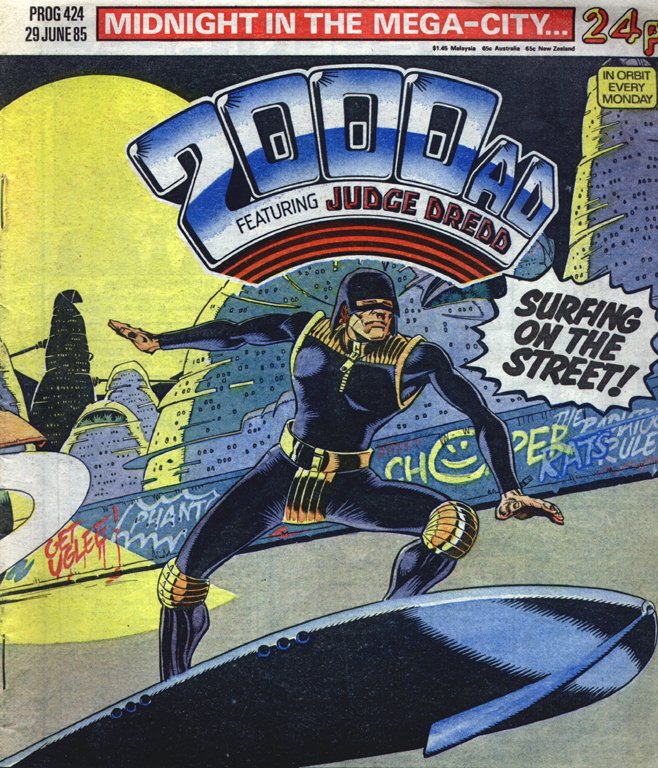
So the pleasures of "Oz" are less about its overall arc than its individual moments. I particularly love the sequence where the turtle gets another chance at life, which lasts all of five panels, but there are lots of other well-turned bits: Chopper going down in the storm, hearing everyone calling his name again; the "Space World" sequence, which gives Barry Kitson an opportunity to draw a very different sort of sci-fi image; McCarthy's image of Wipeout crouching on his board; the color spread being reserved for the final two pages of part 20. (Whoops, that's another one that's not so effective in the printed book.)

The end of "Oz" was, famously, one of the major factors in the end of the Grant/Wagner writing partnership: Grant wanted Dredd to shoot Chopper in the back, Wagner wanted to reserve Chopper for future use. (Wagner has said that "Oz" was less a factor than their miniseries "The Last American" a few years later; Grant claims that Wagner divided up their collaborative gigs at the end of 1987, which would've been right after "Oz." In any case, they kept working together on occasional projects for another decade.) Grant's recollection is that "John wanted Chopper to win, but Dredd to let him go free because he respected him," and says he never read the final episode. In fact, Wagner's ending is a smart solution to the dispute, and doesn't resemble Grant's description.


It's not as if the partnership was producing inferior work (although it probably helped that they don't seem to have been quite as overworked in this period); they'd also gotten back to thinking about Dredd as a long game, setting plot threads that could reach into the future. The Judda routine set up the long-running "bloodlines" sequence, but the most durable invention here is an unlikely one: "Bug," the one-off that introduces PJ Maybe, who's still appearing regularly in the series almost 25 years later. The "young serial killer" premise is in place, and it's clear that they were planning on following it up quickly--but PJ's next appearance didn't happen for over a year, and this appearance doesn't suggest the Adrian Mole-style perception/reality split that would go on to define him. (Its other curious aspect: "Karen Berger Block," which appears in the first panel--Berger was arguably the most forward-thinking editor at DC Comics at that point.)

"Simp"--Cliff Robinson's best-looking story to date--ends with a plug for "Simp About the House," which also wouldn't appear for close to another year. "The Return of Death Fist" wraps up a dangling thread from "The Fists of Stan Lee." And then there's the "Revolution" three-parter, the long overdue follow-up to "Letter from a Democrat" and the most consistently fine story in this volume.


"Revolution" is a particularly timely story this week: it's about a peaceful demonstration, and the dirty tactics authorities use to try to break it up. The democratic coalition's intentions are a lot more specific than Occupy Wall Street's, but it's kind of unnerving that Wagner and Grant assume the people's right to assemble is something even the Judges wouldn't dare to mess with, when that currently seems to be anything but the case. (As Yves Smith puts it: "I’m beginning to wonder whether the right to assemble is effectively dead in the U.S. No one who is a wage slave (which is the overwhelming majority of the population) can afford to have an arrest record, even a misdemeanor, in this age of short job tenures and rising use of background checks.")


I'm a little surprised that "Revolution" appeared more than a year after "Letter to a Democrat," which it echoes formally as well as in plot--the panel where Blondel Dupre is on TV and someone at home is getting bored and changes the channel, and the repeated images of cowed citizens watching the incidents of the march on TV at home, directly repeat a bit from the earlier story. (It's smart that John Higgins draws this story, too, and his artwork here is much sharper than it was on "Letter.") The nasty judicial tricks that pop up in the closing sequences are appropriately shocking--the "family man" bit is particularly clever, and Judge Silver's paternalistic disapproval in his public speech twists the knife.

The only sour note is Dupre's earnest monologue on the final page, which is stirring where it needs to be stinging. Its implication is that we're finally going to be seeing more stories about Mega-City One's residents trying to get out from under the judicial jackboot, and we don't--not for another couple of years, anyway.


The other one- and two-parters in this volume that don't connect to broader developments generally don't have a lot going for them ("Corporal Punishment" is particularly dippy), and it's hard to understand why the thoroughly forgettable "Alabammy Blimps" sequence got five episodes while "Revolution" was squeezed into three. What "Alabammy Blimps" does have going for it is Steve Dillon's artwork, whose conflict-as-comedy approach prefigures the look he'd adopt for Preacher many years later. "Blimps" and Dillon's chapters of "Oz" were the final Dredd stories he'd draw for a few years: shortly after that serial ended, he and Brett Ewins cut way down on their 2000 AD contributions to concentrate on their new magazine Deadline.

Next week: Case Files 12, in which the Wagner/Grant team's split comes into effect, PJ Maybe comes into his own, and both Dredd and the reprints go full color.  

Sunday, September 25, 2011

The Complete Case Files 10

(Reprints: Judge Dredd stories from 2000 AD Prog 474-522)

Of all the Dredd volumes written by the John Wagner/Alan Grant team, this is by far the most inconsistent: its high points are very high, and the low points are unusually sloppy. 1986 was a turbulent time for 2000 AD in general--publisher IPC's Youth Group had been moved to a new building at the beginning of the year (with its art directors separated from editors), and the "British invasion" in American comics was starting to lure top creators away from U.K. publications.

At the same time, the Dredd feature was more in flux artistically than it had been in a long time. These 49 episodes are drawn by 17 different artists. Cam Kennedy draws eight of them, Brendan McCarthy another seven. (A lot of the Dredd covers from this era had nothing to do with the story inside; more than a few were generic, backgroundless action shots drawn by Cliff Robinson.) By the time the final story reproduced here appeared, Wagner, Grant and Kennedy had become part of the British invasion too: they'd been hired to create the miniseries Outcasts for DC. That process evidently wasn't without its bumps, though. The first story Kennedy draws here, "The Art of Kenny Who?," is a very thinly veiled parody of Kennedy's early experiences trying to get work in American comics (wonder who he thought was ripping him off?), and Grant and Wagner naming the martial arts master who defeats Dredd "Stan Lee" has to have had a touch of bitterness behind it.

The McCarthy episodes here stick out from the rest, though. McCarthy's a remarkable artist, especially when he gets to work in color (inexplicably, "Atlantis" was run entirely in black and white). He's also relatively limited in his range. Whatever he draws is a Brendan McCarthy image before it's anything else, and he's much more interested in bombarding readers than leading them through a page. That works fantastically well for covers, and for projects like Strange Days. It's less effective for crime plots like "Atlantis" and "The Witness," in which McCarthy's style and spectacle (and his cluttered layouts) keep kicking the reader out of the story.

Grant and Wagner had set up some possibilities for expanding Dredd's world in the previous year's stories, but mostly ignored them here--although this batch does include a a string of stories that follow up on much earlier episodes. "Pinboing Replay" is a sequel to "Palais de Boing," and brings Max Normal out of his unannounced retirement for what must have seemed like one final bow. As it happens, Max had actually appeared in a solo story a month earlier, in the 1987 Judge Dredd Annual--by the "Bad Company" team of Peter Milligan, Brett Ewins and Jim McCarthy. (For some reason, it doesn't appear in the BARNEY database's listing.)

"The Interrogation," the best-looking Dredd story Kim Raymond ever drew, follows up on that terrific apropos-of-nothing scene in "The Executioner" four years earlier in which Dredd grills Judge De Gaulle. (Have we seen her since?) And "10 Years On," which ran in the tenth anniversary issue, Prog 520, revisits the very first printed Dredd story, "Judge Whitey." 520 was also, I believe, the first issue to feature painted color in the center-spread and a slightly different trim size; from that point onward, the black-and-white reproduction in this Case Files volume and the next is even more frustrating than before.

Also frustrating: the string of stories, especially in the second half of this volume, on which Wagner and Grant are on autopilot. I could swear that there's been another Dredd story at some point with exactly the same premise as "The Peeper"--busybody with telescope discovers crime, reports it, is told to spy for Justice Dept. from then on--although I can't recall exactly where. The crazy-robot-on-the-loose story "Phantom of the Shoppera" is immediately followed by the crazy robot on the loose who opens "Tomb of the Judges"; the fourth-wall-breaking and deus ex machina routine in "A Real Xmas Story" are forced; "The Beating Heart" doesn't bother to twist "The Tell-Tale Heart" into anything new; the Michael Jackson and genie-in-the-lamp and blind-monks and time-traveling-Jack-the-Ripper stories are all dumb, lazy writing (although the Michael Jackson one features a rare comedy turn from Garry Leach). The low point is "The Shooting Party," a half-assed retread of "The Hunters' Club."

Still, Grant and Wagner pulled out some classics in this period--most notably "The Taxidermist," a showcase for Kennedy's character-acting work, which builds on a twisted, original premise, manages to be both suspenseful and hilarious, and ends on a marvelously unexpected note. The opening gag (with Don Giovanni playing the role of the Stone Guest) is particularly great. Extra points for underselling several jokes in this sequence:
Well, underselling them by 2000 AD's standards, anyway. (The routine about Sardini's Olympic performance is funny enough that it became the basis of the later Taxidermist stories.)

There's some other thoroughly charming stuff here too, like the only Dredd stories Kevin O'Neill has drawn to date, "The Law According to Dredd" and "Varks" (plus his page of "What If the Judges Did the Ads?"), all of which play to his sense of extreme grotesquerie. And the central gag of "Paid with Thanks" (drawn by Ian Gibson under his Q. Twerk pseudonym again) has stuck with me for 25 years now.

What's missing most from this volume, though, is the Dredd series' sense of worldbuilding and change over time. We get to see Atlantis and find out about Cal-Hab, and there's a tiny hint of a bigger picture near the end, with "The Blood Donor" and its line about "casualties in the present colony war," a war we hadn't heard about before, and, I believe, wouldn't hear about again. But the democracy movement, Dredd's fears of fallibility, the internal turbulence in Justice Department, the hints of a future disaster--all the slow-fuse stuff that kept the previous couple of volumes thrilling? All of that is missing from this period. (That would change dramatically a few months after this volume ended, though.)

A few more notes: Most of the first ten years' worth of Dredd stories from 2000 AD (with the exception of the suppressed "Cursed Earth" episodes, obviously) have been officially reprinted several times over. Before the Complete Case Files series, the most complete version was the magazine-format Complete Judge Dredd and the Classic Judge Dredd series that followed it. Classic, though, made an abrupt jump: after Prog 519's "Blood Donor," it filled out its fourteenth issue with a Daily Star reprint, then skipped straight to "Oz" (which it reprinted over its final four issues).

The final story in Case Files 10, "So You Want to Be a Judge?," is consequently the first that had never been reprinted before the Case Files books. It's actually incomplete here: the final page in the original version was a "cadet application," at the bottom of which Tharg promised that the winner would appear as a cadet in a subsequent issue. And "The Dead Ringer," from Prog 493, was a little bit of a milestone in its own way: it was the first Dredd story in 2000 AD to be credited to "Wagner & Grant," rather than to "T.B. Grover."

Next week: Case Files 11, featuring "Oz"--the Wagner/Grant team's final epic--as well as "Revolution" and the first appearance of P.J. Maybe. 

Sunday, September 18, 2011

The Complete Case Files 09

(Reprints: Judge Dredd stories from 2000 AD Prog 424-473)

This is the volume where things start changing in a big way, and its crucial episode supposedly happened as a near-accident. If you believe this Alan Grant interview--which I'm not entirely sure I do--the story planned for Prog 460 was originally going to be called "Letter from a Baffin Island Nudist" until that premise was rejected; Grant and John Wagner rummaged about for a moment to figure out who a letter could be from, and came up with "Letter from a Democrat."

For those of you who haven't read it, the result was a 7-page story narrated by a mother of two small children, who forces Dredd to kill her so she can be a martyr for the pro-democracy movement. It might be the biggest pivot point of the whole series. Dredd had been a fascist from the get-go, and Wagner and Grant had always made great sport of having him stomp on various basic rights. They'd been pushing that point pretty hard over the previous few months--"The Man Who Knew Too Much," in particular, is a harsher "yes, the Judges are doing terrible things to maintain their power; no doing anything about it" story than they'd published before.
But after Hester Hyman's sign-off ("what kind of mother could stand by and see her babies grow up into frightened, beaten people like us?"), it got a lot harder to show Dredd as a hero, or even an antihero, or as anything other than as the willing champion of a despicable system. Dredd stories tend to end with some kind of comedic or ironic flourish; the last thing in this one that can pass for an (ice-cold) joke in this one is Dredd's admonition to the husband of the woman he's just killed: "Let this be a lesson to you... Democracy's not for the people." Which reminds me: have we seen Simson Hyman or Gort Hyman Jr. at all in the past 20 years or so?

In retrospect, "Letter from a Democrat" was a terribly risky move; it's so powerful, and shows Dredd in such a revealing and unflattering light, that it could have torpedoed the series. Instead, as we'll see over the next few volumes, it blew the doors open: it established that Mega-City One's political grounding could change--and would have to change very slowly. (The panel in which the at-home viewers are getting bored of the Democratic Tendency's demands and one of them yells at another to change the channel foreshadows the "referendum" storyline of a few years later.) And establishing a second frame of reference for understanding the Judge system, as a horrible jackbooted force of oppression, within the story (instead of just letting readers in on the joke), opened up some rich story possibilities. It led directly to other memorable sequences, but it also made possible every story we've seen in the past 25 years about how Dredd, and the Judges in general, might be terribly wrong.

"Letter from a Democrat" isn't John Higgins' finest Dredd work by a long shot, but I'd say that it's the peak moment of Alan Grant's influence on the strip. Grant notes in the interview mentioned above that his own ideas about politics came out in Anarky rather than Dredd, but his conception of Dredd is that he's an irredeemable, inhuman terror, which is the role he plays here. Wagner's Dredd, conversely, is not quite inhuman: he's just so far out of touch with his human and compassionate impulses that on the rare occasions he has them he doesn't understand them for what they are. He's capable of skirting or ignoring the law, or even wanting to change it, in his own self-interest, but he's incapable of understanding that he has a self-interest, so when he does the right thing it's usually for the wrong reasons.

And for all of "Letter"'s classic beats, when I went back to look at it for this project, this was the panel that snuck up on me:
Something about that really gets to me: they're not just willing to die for their principles, they actually live by those principles.

The other particularly great sequence in this volume is its opener, "The Midnight Surfer"--the second Chopper story, building on a throwaway "sky-surfing" gag from a Daily Star strip. (There'd been a "Norrin Radd" joke in another episode, though; wish I could remember which one.) The Supersurf competition is a clever variation on 2000 AD's extreme-sports formula--a thrilling idea with a terrific visual component, pushed far enough that there's the constant threat of bloodshed.
This is also the story where Chopper's role as one of Dredd's great adversaries is solidified, and surfing is a much better visual metaphor than tagging for the position he occupies: a thrill-seeker who simply doesn't care about what Grant (in that interview again) calls "enforced authority--which is what democracy comes down to in the end, as well." He looks out for himself, he looks out for his friends, and it doesn't bother him at all that his hotdogging can be a public menace.

"The Midnight Surfer" rockets along for almost its entire length, but there are a lot of smart little reversals and loop-de-loops built into it: the end of the first episode revealing that the surfer is Chopper, although we've already seen his face on the first page; the comment that the young-perp rehab program has a 91% recidivism rate; the image of Dredd from Chopper's upside-down P.O.V.; the gag that Chopper doesn't think Dredd is onto him, not realizing that he's more concerned with stopping Supersurf. And what a brilliant ending: Chopper being led away to the cubes while everyone cheers his name is one of my favorite Dredd moments of that era.
That's partly down to Cam Kennedy, who's in top form. After a couple of trial episodes in the previous two volumes, he becomes a big part of the Dredd crew with this one, drawing 21 of its 50 episodes, including most of the multi-parters. Kennedy's artwork isn't as funny as Ron Smith's, or as rugged as Carlos Ezquerra's; still, it's stylish and dependable, and he's very good with storytelling and (when he gets a chance) character acting. He sneaks in striking images in unexpected places, too, like the blobject-cityscape that opens part 3 of "The Falucci Tape." (Ex-Judge Sladek would have gotten back from Titan sometime around 2006; I wonder if Yolanda waited for him. A lot of those "twenty years on Titan" sentences would've run out by now...)

Wagner and Grant apparently really liked working with Kennedy, too, viz. the later "Kenny Who?" sequence and their yearlong collaboration with him on Outcasts for DC. One particular quirk of Kennedy's work: he seems to really like drawing costumes that obscure characters' faces. Obviously that works for Dredd, but Flip Marlowe in "The Big Sleep" never gets much of a chance to seem human.

Anyway. Having gone all-out on "The Midnight Surfer," Grant and Wagner immediately retreated to older, sort-of-reliable formulas: Dredd vs. the monster who takes advantage of people's farcical politeness ("Nosferatu"), a rhyming musical parody ("West Side Rumble"), an Otto Sump routine ("Get Smart"), defective robots ("Something Abnormal About Norman"), the Fatties ("The Magnificent Obsession"). The last of those is at least a welcome variation on the formula--for once, the fat-guy protagonist's story doesn't end in tragedy, and his kid's line about "you can eat me if it'll do any good, dad" doesn't foreshadow something awful. The throwaway line at the beginning of "The Magnificent Obsession" about how the post-Apocalypse War food shortages are over now puts that era of the series to rest, too.
The one-offs that occupy most of this volume sink or swim on the strength of their artists. Ron Smith, who'd been such a big part of the weekly Dredd team for the past few years (and was still drawing the Daily Star strip), was phoning it in for most of his episodes in this volume, and after "The Lurker" he all but disappeared from Dredd's 2000 AD series for eight years or so. On the other hand, even though "Riders on the Storm" isn't a terribly compelling concept, it looks ravishing (especially that cover): Brendan McCarthy and "Riot" (Tony Wright) could make anything look like... a Brendan McCarthy story. Too bad these early Case Files volumes have black-and-white reproduction of their color pages.
"Love Story" is a silly throwaway, but it's got some nice art from Ian Gibson, and Wagner and Gibson would return to its premise for two sequels, in 1991 and 2002. Gibson also appears later in this volume with a pair of stories credited to "Q. Twerk," i.e. "cute work"; it hadn't been long since he'd signed Dredd stories as "Emberton." Anybody know why he would use one pseudonym or the other or none? I've been trying to figure out if it correlates with his various inking techniques, and it doesn't seem to. (Speaking of pseudonyms, note that the cover to the issue including "The Last Voyage of the Flying Dutchman" bills it as "Wagner's Flying Dutchman." That's a Richard Wagner joke, of course, but 2000 AD's readers wouldn't have understood why it was relevant: at the time, the Wagner/Grant Dredd stories were still credited to "T.B. Grover.")
2000 AD had always been fan-response-driven, and fans obviously wanted to see their favorite characters again and again; the problem was that some of them could get badly overexposed. The prime exhibit of that here is "A Merry Tale of the Christmas Angel." It's a solidly constructed little one-off that still has to scrape the barrel to get Mean Machine back on stage, and once he's there, there's simply not much to do with him. He's totally safe! But then he gets reminded of how much he hates Dredd! And then he goes into a headbutting frenzy! We'd seen that routine before; after this episode, it'd take Wagner more than five years to figure out how to bring back Mean again without repeating it.

If the writing seems a little unfocused in the later stories in this volume, that may be because this was the period when Wagner and Grant were, between them, writing almost the entirety of 2000 AD--in addition to Dredd's weekly episode, the weekly Daily Star strip and its daily companion (which had launched at the beginning of 1986), they were writing the Judge Anderson series and Ace Trucking Co., and Grant was writing Strontium Dog and Bad City Blue. There were a few issues where the only non-Grant/Wagner strip was a single page of "Sooner or Later."

The "Warlord"/"Seven Samurai" sequence, in particular, drags on a bit (and the Japanese stereotypes get old really fast), although it does do the service of dispatching the ultra-dull Judge Omar, and setting up the (first) resignation of McGruder... after an unrelated story the following week. (Oh, deadlines.) "A Chief Judge Resigns," on the other hand, is a thrilling little piece, especially considering that it has no action sequences at all, is entirely about internal politics, and introduces a new character (Silver) while announcing rather than showing how important he is. Its cleverest beat is McGruder firing the council members who were loyal to her on the grounds that that showed poor judgement--she comes off as the hardass to end all hardasses. Curious that she doesn't appoint anybody from Psi-Division to the new council, too: were Grant and Wagner trying to distance the Dredd and Anderson series? They weren't distancing them much--Corey shows up a few months later in "The Exploding Man."
Finally, "The Secret Diary of Adrian Cockroach" isn't as funny as it ought to be, and contemporary readers--especially Americans--might not catch that it's a parody of the then-popular Sue Townsend novel The Secret Diary of Adrian Mole. (Pandrop's name is a reference to Adrian's girlfriend Pandora.) But Grant and Wagner would take another, much more successful crack at an Adrian Mole parody a year and a half later, with "Bug" and P.J. Maybe.

Next week: Case Files 10, with "Atlantis," the first Taxidermist story, and more! 

Sunday, September 11, 2011

The Restricted Files 02


(Reprints: Judge Dredd stories from 2000 AD Sci-Fi Special 1985-1988, 2000 AD Annual 1986-1990, Judge Dredd Annual 1986-1990, Judge Dredd Mega-Special 1988-1989, 2000 AD Winter Special 1988-1989)

Of all the Dredd collections that have appeared in the past decade or so, the Restricted Files are the hardest to get a handle on. The Case Files show the series' week-by-week evolution; the other collections are usually united by a character or theme or storyline. Even the Mega-City Masters volumes (and we won't be getting around to those until February or so) have a focus on different approaches to writing or art. These, though, are united only by the fact that they don't fit directly into the weekly continuity of the series.

Fortunately, the second volume is way better than the first. It's still something of a sprawl, covering the mid-1985 to late 1989 period (the first story in here, "I, Beast," appeared in the 1985 2000 AD Sci-Fi Special, which seems to have come out the same week as Prog 420), and the John Wagner/Alan Grant team splits into Wagner-or-Grant halfway through it. This time, though, the art is much more solid, a lot of it's in full color (pretty high-end color by '80s comics standards), and in a few cases Wagner and Grant clearly wrote it for color artwork.

The most obvious example of that--and the best-looking story here--is "Report to the Chief Judge," in which Brendan McCarthy and Tony "Riot" Wright get to draw Dredd literally tripping on hallucinogens for 16 pages and offhandedly killing someone who's just trying to help him--it took me a couple of read-throughs to figure out who the citizen Dredd killed even was. (Above: an unrelated McCarthy cover from a few years later.) As a bonus, Brian Bolland got to take on the psychedelic effect when he drew a cover for the Fleetway reprint of the story in Judge Dredd's Crime File, a series whose other three covers all featured Dredd in a much blander front-and-center pose:

The other story drawn by McCarthy here, "She-Devils," is also lively and psychedelic; unfortunately, it's a pretty straightforward crime story in which that effect is a bit of a head-scratcher, beyond the gorgeous neon-signs splash page. Also notable: a rare appearance of Dredd's former rookie Judge Dekker. "Blockers" is a particularly odd story--not only is it four pages of color followed by one in black and white, but no Judge appears in it at any point. (It's also another misfire by José Casanovas: his MAD-inspired comedy is fine for the character designs, but his layout completely garbles the action on the final page.)

But the smartest use of color in this volume is "Beyond the Wall," from the 1986 Sci-Fi Special: it's crucial to its impact that the final two pages of the story are in color. That story's also the first appearance of Dink Jowett and Martha Fitzenheimer, and lays the groundwork for the Banzai Battalion business a decade or so later.

It's also fun to consider which of these stories might just as well have appeared as regular Dredd episodes (or multi-part stories) in the 2000 AD of the time, and which were clearly put together for the annuals and specials. "Crime Call," for instance, is a straight-up regular seven-pager, down to its goofy call-in-show conceit. (John Higgins' coloring is a lot less subtle than I usually think of his stuff as being: it wasn't long after this story, in fact, that he started working on Watchmen.) The same goes for the Ian Gibson-drawn story about the hijack & hostages (can it really be called "Meanwhile..."?). On the other hand, the second big Higgins story here, "Last of the Bad Guys," is very broadly paced--he stretches out in a way that no artist had really done in 2000 AD.

Likewise, "The Horsemen of the Apocalypse"--the extended it-was-all-a-dream fantasy that starts off as a riff on a heat wave and gradually progresses toward Dredd imagining himself on the business end of a nuke--wouldn't have made any kind of sense in seven-page chunks. It reads considerably differently from any other Dredd story of its time, and not really in a good way. Still, Mike Collins/Mark Farmer art team on "The Horsemen of the Apocalypse" is promising, in a sort of quasi-Cliff Robinson mode, with a touch of Kevin O'Neill near the end. (Collins would return to draw Dredd a few times over the years, most notably in the Daily Star strip and the recent "Tour of Duty" sequence.)

A few other notable things: "John Brown's Body" and "Crazy R Raiders" (both from the 1986 Judge Dredd Annual, pictured above), as well as the lengthy "Costa Del Blood," are among the very few Dredd stories Carlos Ezquerra drew between "Requiem for a Heavyweight" in 1983 and his return to the feature in mid-1989. Unfortunately, none of them are Ezquerra at his best--the colors are so garish and sloppy that they get in the way of his storytelling. 

"Headbanger" anticipates the Rock Power/Heavy Metal Dredd material by a few years, although it's a lot less visually attractive. "Confessions of an Anarchist Flea," another Grant-written story, is surprisingly rather down on anarchist rhetoric--particularly given that Grant went on to co-create Anarky over at DC not much more than a year later. And in "Ladies' Night," from the 1987 2000 AD Annual, there's apparently a law against cross-dressing; as of the Anderson Psi Division story "The Random Man" in prog 658, in December, 1989, there's no such law (any more). Nice to see a bit of progress there.

"The Gaia Conspiracy" is a genuinely weird one--I like Phil Elliott's artwork in the context of his creator-owned work, but in a Dredd story it's as far off-model as anything that had been published in a decade. And the conceit of taking a metaphysical interpretation of James Lovelock's "Gaia hypothesis" seriously in a Dredd story is much more something Grant would write than something that would be likely to happen on Wagner's watch; this looks to have been one of Grant's first solo Dredd stories following the end of "Oz" and the dissolution of their partnership. A little note on the timeline: "the last time [Dredd and Corey] worked together" was Prog 471, May 24, 1986, which we'll be getting to next week in Case Files 9; "The Gaia Conspiracy" appeared in Sci-Fi Special 1988, dated June 1, 1988; Corey's suicide was in Sci-Fi Special 1989, dated May 1, 1989.


Surprisingly, the final third of this volume is the wobbliest. One of Wagner's signature tricks is interpolating song lyrics into his stories (see, e.g., "America," the opening storyline of "Legends of the Law," and even the Country Joe routine in "The Apocalypse War"), but "Joe Dredd's Blues" comes off as a halfhearted mumble, despite John Higgins opening all the neon paint-cans. "A Night at the Basho" is the kind of forced throwaway that might have appeared eight years or so earlier. "Son of Ratty's Revenge" is altogether too lush-looking for a pointless little coda to the Angel Gang stuff. Mark Farmer's artwork on "Stunning Stunts Club" somehow has the look of American comics about it, which doesn't seem quite right. (I suspect the fact that the very high building is called "Shooter Towers" might be a reference to Jim Shooter, too.)

Similarly, as impressive an artist as Arthur Ranson is, his straight-faced, slightly gritty realism doesn't really click with this series; as he put it, four of the five Dredd stories he's drawn "were 'humorous,' which I didn't really feel suited to." The fifth, slightly more serious one is "The Dungeon Master," which doesn't quite work as a story, either--Wagner's script seems oddly alienated from the tropes of role-playing games. That, in turn, points out a significant omission from this volume of The Restricted Files: "House of Death," the 18-page story (by Grant, Wagner and Bryan Talbot) that appeared in the first issue of the bizarre, short-lived RPG/comics hybrid Dice Man in 1986. The splash page is below; if you really want to see the whole thing, somebody appears to have put up a Flash version of it.

Next week: back to the Case Files, with vol. 9 and the return of Chopper!

Sunday, September 4, 2011

The Complete Case Files 08

(Reprints: Judge Dredd stories from 2000 AD Prog 376-423)

Two years after the end of "The Apocalypse War," its spectre was still looming over Judge Dredd, but Alan Grant and John Wagner had pretty much run out of "post-war" plot kernels. (The anniversary parade at the beginning of "Question of Judgement" is a good gag, with a mushroom cloud and a pile of bodies staged as floats, but that's about it this time.) It's clear that the mega-epics were very popular, but that they were also exhausting to pull off.

And it must have been a mighty task to come up with a new angle for an epic: since the premise of the series is the relationship between the protagonist and the city, there are only so many ways to get a long story out of upending that relationship. Pat Mills had already done the "Dredd goes out of the city into a very un-city-like environment" plot (and Wagner and Grant revisited the Cursed Earth for "Helltrekkers," a 29-part serial that ran from Prog 387 to Prog 415, and has been reprinted a couple of times but never as a book, but let me tell you, you're not missing anything). Wagner had done the "Dredd moves to a different city" plot and the "Dredd leads the rebellion against the new leadership of the city" plot. They'd done the "Dredd leaves the city and the planet and goes on an outer-space quest" plot. Then they'd done the "city becomes a war-zone, thereby changing all the rules" plot.


So for the first third of this volume, you can see Grant and Wagner casting about for ways to make the feature stay fresh. "Dredd Angel" is the best thing in the volume--it's very funny most of the time (the gag about "the lost treasures of Liberace" is an excellent conceit, if one likely to be lost on British 14-year-olds in 1984), and Ron Smith plays a couple of scenes for comedy that other artists would have treated as straighter violent chaos. Look at the way he draws Dredd running after Mean Machine here--that's practically a Bugs Bunny pose.


It's fair to say, though, that "Dredd Angel" is a rewrite of "The Cursed Earth" with a little bit of "Destiny's Angels" spliced into it: once again, Dredd has to go (via land, for a similarly opaque reason) across the badlands to deal with a McGuffin, with an unreliable/violent guide. Still, it opened up the "clone bloodline" plot that would bear fruit a few years down the line.

It also looks particularly elegant by comparison with "Gator," which follows it. Turns out I'm not the only one who's not crazy about Kim Raymond's artwork: both writers were particularly unhappy with it. (Grant: "We tried and tried to stop Kim Raymond ever doing Dredd again... Some really poor artists have done Dredd and Kim Raymond did the worst Dredds of all." Wagner: "Why, for instance,  give Dredd to an artist like Kim Raymond, who was so obviously unsuited?")


The "Question of Judgement"/"Error of Judgement"/"A Case for Treatment" sequence was another potentially interesting avenue--Dredd questioning his own actions and dealing with the long-term effects of being a state killer--that Wagner and Grant went about in a way that quickly turned into a dead end, and immediately abandoned. (It's very strange to see Dredd being suddenly self-reflective and soft-hearted; it doesn't open him up as a character so much as go directly against what we know about him.) "A Case for Treatment" also seems to have been written as a lead-in for "City of the Damned" before "The Wally Squad" was abruptly slotted into place--there's an amusingly awkward bit of dialogue at the end, where McGruder says she's about to give Dredd "his sternest test since the Apocalypse War"... except for this other thing he has to do first.


"City of the Damned" was an awkward proposition from the beginning (four artists in 14 episodes!); according to Thrill-Power Overload, it was originally supposed to be another half-year-long epic, but at some point Grant and Wagner decided that it wasn't working and wrapped it up pronto. It does manage to come up with another variation on the relationship between Dredd and the city--the time-travel plot means that he could be in the same place but find it in ruins (and overrun by the vampiric Judges, a.k.a. the "Hell Street Blues," a joke I'm guessing has largely been lost to time). And teaming Dredd up with Anderson again (and making him relatively helpless and reliant on her) was a welcome touch.


The problem was that Wagner and Grant were clearly not particularly into the story--separating Dredd from most of his supporting cast meant that it was just one fight scene after another. That final episode is pretty action-packed (although Ron Smith still seems not to be too certain of how to draw McGruder--compare her appearance here to "A Case for Treatment"), but there's a palpable sense of "well, that's over with!" at the end of it.

(A historical note: Prog 403, right near the end of "City of the Damned," had the first time Bolland Dredd cover in 2000 AD proper in a while, although it was actually just his cover artwork for "Mutants in Mega-City One," a one-off single by the Fink Brothers, a.k.a. a couple of moonlighting members of Madness.)


The final third of Case Files 08 is the weakest Judge Dredd had been in years, partly because of artistic inconsistency (the five-parter "The Hunters Club" involves three very solid artists with not-terribly-compatible styles), but mostly because Grant and Wagner were phoning it in. "Juve's Eyes" is something of a low point, thanks to its "comedy" Spanish accents (and a very thinly disguised slur)--Judge Dredd is so far ahead of the curve in a lot of ways that it's particularly grating to run into retrograde crap like that. (See also: bits of the first Hondo City story.) Also, it's thankfully been a while since a vagrant in the strip was referred to as a "vag."

"99 Red," the final story in here, was also the final story reprinted in the Complete Judge Dredd magazine-format series of the early '90s. (That series was promptly replaced by Classic Judge Dredd, which went up to the end of "Oz," i.e. the end of Case Files vol. 11.) I can't even tell what's supposed to be happening at the end of the episode: the next-to-last caption ("Sleever may never recover. But with luck--and careful laser surgery--Sleever could be back on the streets within days") makes no sense. Besides, wouldn't Sleever just be shipped off to Titan?


Still, there are a few jewels among the lumps of coal. "Thirteenth Assessment" is a cute take on the "Dredd and the rookie" formula, and Judge Brisco actually turned up again in 2000 AD just a few weeks ago. (I guess his mom got out of jail sometime around the end of "The Satanist.") "Sunday Night Fever" (which features Arthur Koestler Block leapers again!) finds Cam Kennedy trying to work some of his Mike McMahon-isms out of his system, but it's a nice-looking piece as it is. In the prog after this volume ends, Kennedy would draw the first episode of the next great Dredd story. But that will have to wait until the 18th: next week, we take another detour into color, as we arrive at the second volume of The Restricted Files.